A road trip is one of the few kinds of travel where a small purchase can make a surprisingly big difference. The right accessory can make navigation safer, prevent a minor tyre issue from becoming a ruined day, or simply help you arrive without a sore back and an empty phone battery. The trick is not to buy every gadget marketed to drivers. Most of those end up in the boot, unopened. A better approach is to pack a small set of things that solve real problems on the road.
This guide focuses on nine accessories that are genuinely useful for a car road trip in India: a secure phone mount, a fast car charger, a tyre inflator, a jump starter, a compact first-aid kit, driving sunglasses, sunscreen, a power bank and a lumbar cushion. These are not replacements for routine vehicle maintenance. Before leaving, still check tyre condition and pressure, engine oil, coolant, brakes, lights, insurance, registration documents and roadside-assistance details. Think of the accessories below as a practical layer of comfort and self-reliance once the trip begins.
1. A secure phone mount: safer navigation at a glance
Navigation is usually the most-used tool on a road trip. A phone lying in the cup holder or on the passenger seat is awkward: every turn prompts you to look away from the road, and every bump sends it sliding somewhere inconvenient. A good phone mount keeps the map visible at a quick glance, lets you use hands-free calls where legal and appropriate, and stops the constant reach-and-adjust distraction.
For a road trip, stability matters more than a fancy design. Look for a mount with a firm dashboard, windscreen or CD-slot attachment; a one-handed clamp; and an adjustable arm that does not block your view of the road. Vent mounts are compact, but they can be less secure on rough roads and may interfere with airflow. Magnetic mounts are convenient, though the magnet and plate need to be compatible with your phone case. Whichever style you choose, mount the phone low enough to preserve visibility, but high enough that you are not looking down into the cabin.
A solid option to compare is the Spigen OneTap Pro car mount range on Amazon India. It is worth paying for a mount that remains steady over potholes; this is a safety item, not just a convenience accessory.
2. A fast car charger: keep the trip’s essentials alive
On a long drive, your phone is doing more than usual. GPS, a bright screen, mobile data, music streaming, Bluetooth and calls all draw power. Many basic 12V USB adapters only slow the battery drain rather than recharge the phone. A fast car charger makes the phone mount genuinely useful: you can keep navigation running without arriving at your destination with 5% battery.
Choose a charger with USB-C Power Delivery (PD) if your phone supports it, and check your phone’s maximum charging speed. A charger with both USB-C and USB-A ports is helpful when travelling with family or friends. Do not forget the cable: use a good-quality cable rated for the charger’s output, ideally one that is long enough to reach the mounted phone without stretching across the dashboard. Avoid very cheap unbranded adapters, which can become hot or provide inconsistent charging.
For a reliable starting point, compare UGREEN USB-C PD car chargers on Amazon India. The best choice depends on your phone and whether you need to charge one device or two, but fast USB-C output is the feature to prioritise.
3. A portable tyre inflator and pressure gauge: the quiet trip-saver
A tyre inflator is one of the most useful accessories you can own even if you never have a puncture. Tyres naturally lose pressure over time, and a car carrying passengers and luggage can feel noticeably worse when a tyre is underinflated. Correct pressure improves handling, supports even tyre wear and helps fuel economy. It also gives you a chance to deal with a slow leak before it becomes a roadside problem.
A portable electric inflator with a digital gauge is the easiest option. It allows you to set the pressure recommended on your car’s door-jamb sticker or owner’s manual, then automatically stops when it reaches that number. Check that the model can reach the pressure your car requires and that its power source suits you: some run from the 12V socket, some have a rechargeable battery, and some offer both. Keep it accessible rather than buried under luggage. It is for topping up air, not for repairing a puncture or replacing a damaged tyre.
The Xiaomi Portable Electric Air Compressor 2 is a popular compact style to compare. Before the trip, test it once at home and learn the target pressure for all four tyres.
4. A jump starter: independence when the battery gives up
A weak battery does not always give much warning. Leaving a cabin light on, taking repeated short drives, cold weather in hill stations or an ageing battery can leave the car unable to start. Traditional jumper cables work only if another vehicle is available, positioned safely and driven by someone willing to help. A lithium jump starter gives you a more independent solution.
Buy a model rated for your engine size, particularly if you drive a diesel SUV. Look for reverse-polarity protection and clear instructions, then read those instructions before you need them. Keep the unit charged; a jump starter stored flat for six months is not much help. It should be viewed as a contingency tool, not a way to ignore a failing battery. If your car frequently needs a jump, have the battery and charging system inspected.
The NOCO Boost Plus GB40 is a well-known benchmark product to compare, though it can be more expensive than basic alternatives. Whichever brand you choose, match its starting-current rating to your car.
5. A compact first-aid kit: useful for the small stuff
A first-aid kit is not about expecting an emergency; it is about being prepared for the minor issues that are common during travel. A scrape while unloading luggage, a blister from a walk, a small cut at a picnic stop or a headache on a long day should not require hunting for a chemist. A compact kit takes almost no space and is worth having even for regular city driving.
Look for adhesive bandages in several sizes, sterile gauze, antiseptic wipes, tape, scissors, gloves and a crepe bandage. Then personalise it: include medicines you normally use, motion-sickness medication if appropriate for your group, and any prescribed medicine in its original labelled packaging. Check expiry dates before every major trip. Keep the kit within easy reach in the glovebox or door pocket rather than under a pile of bags.
Start with the compact car first-aid kit options on Amazon India, then add the personal items your travellers need. For a serious injury, seek professional medical help; the kit is only for immediate basic care.
6. Polarised driving sunglasses: less glare, less fatigue
Driving into a low morning or evening sun can be exhausting. Glare reflects off roads, bonnets, windshields and wet surfaces, making it harder to see clearly and forcing your eyes to work harder. A pair of comfortable sunglasses is one of the simplest ways to make a long daytime drive more relaxed.
For driving, prioritise UV protection and a lens tint that does not make the road too dark. Polarised lenses can reduce reflected glare, although some drivers may find certain digital displays look unusual through them. Avoid lenses that are excessively dark, especially if you might drive near sunset or through tunnels. Keep the glasses in a hard case so they do not get scratched under the seat or dashboard.
You can compare Fastrack polarised driving sunglasses for a practical, easy-to-replace option. Fit is more important than branding: they should stay comfortable for several hours without pinching your nose or temples.
7. Sunscreen: a road-trip essential hiding in plain sight
It is easy to forget sunscreen when you are travelling by car, but road trips include fuel stops, viewpoints, meal breaks and hours near side windows. Sun exposure adds up, especially on a day spent driving through open highways or coastal and hill routes. A small sunscreen tube belongs in the same easy-access place as your sunglasses.
Choose a broad-spectrum SPF 50 product that feels comfortable enough to reapply. For most people, a non-greasy gel or fluid is easier to use during travel than a heavy cream. Apply it before you leave, then reapply during longer outdoor stops. If you have sensitive skin, use a product you have already tried rather than experimenting on the day you start the trip.
A familiar choice is Neutrogena Ultra Sheer SPF 50+. The exact formula is less important than consistently using one that suits your skin.
8. A fast-charging power bank: your backup to the car charger
The car charger should handle most of your in-car charging. A power bank is the backup that helps when the engine is off, the charging socket is occupied, you are away from the car, or more than one person needs power. It is also useful if you stop somewhere remote and want your main phone to remain charged for navigation and calls.
For most road trips, 10,000 mAh is the sensible balance of capacity and portability. Choose 20,000 mAh if you are travelling with multiple people, cameras or several days away from reliable charging. USB-C input and output, fast charging and recognised safety certification matter more than the biggest number printed on the box. Charge it fully before departure, bring the right cable, and do not leave it baking in a hot parked car.
Compare the Anker Zolo USB-C power-bank range for a quality-focused option. If you use an iPhone with MagSafe, a magnetic unit can be convenient at stops, but wired charging is typically more efficient.
9. A lumbar cushion: arrive with a better back
Car seats are designed to suit a wide range of bodies, which means their lower-back support is not always ideal for you. After a few hours, many drivers start to slouch, shift in the seat and feel stiffness around the lower back. A slim lumbar cushion helps maintain the natural curve of the spine and can make a substantial difference on a long drive.
Choose a cushion that is firm enough to support you but not so thick that it pushes you too far forward. Memory foam is comfortable, and an adjustable strap prevents the cushion from sliding down the seat. Test its position before departure: it should sit in the small of your back, not halfway up your spine. If you have persistent back pain, see a medical professional; a cushion can improve comfort but is not treatment.
The FOVERA memory-foam car lumbar-support range is worth comparing. Pair it with regular driving breaks and a short walk every couple of hours.
The smart way to buy and pack this kit
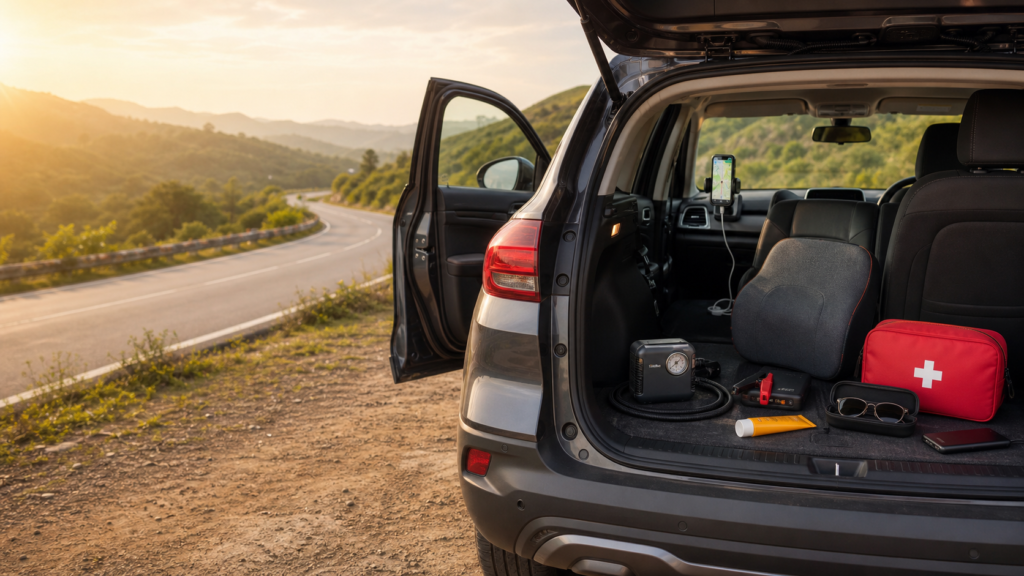
You do not need to buy everything at once. If your budget is limited, start with the phone mount, fast charger, tyre inflator, first-aid kit and sunglasses. Add the jump starter if your car battery is older or you will drive through remote areas. A power bank and lumbar cushion are particularly valuable for multi-day trips and long stints behind the wheel.
- Keep the phone mount, charger and sunglasses in the cabin.
- Place the first-aid kit and power bank where they are easy to reach.
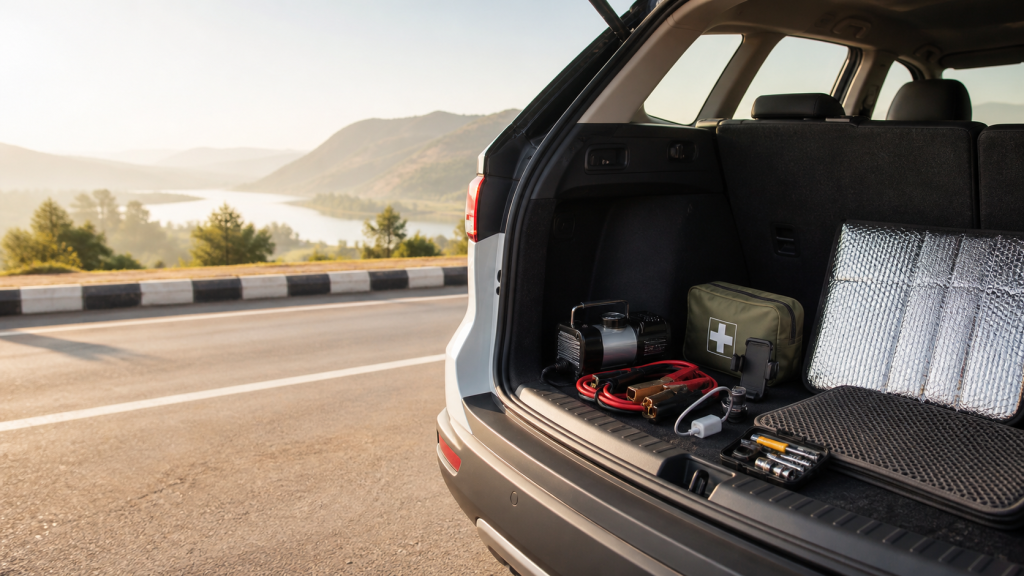
- Keep the inflator and jump starter protected but accessible in the boot.
- Charge the jump starter and power bank the night before leaving.
- Test every electronic accessory before the trip, not on the roadside.
The best road-trip accessories are the ones you barely notice—until the moment they solve a problem. Buy thoughtfully, test the kit once, and then focus on the route, the people travelling with you and the places you set out to see.