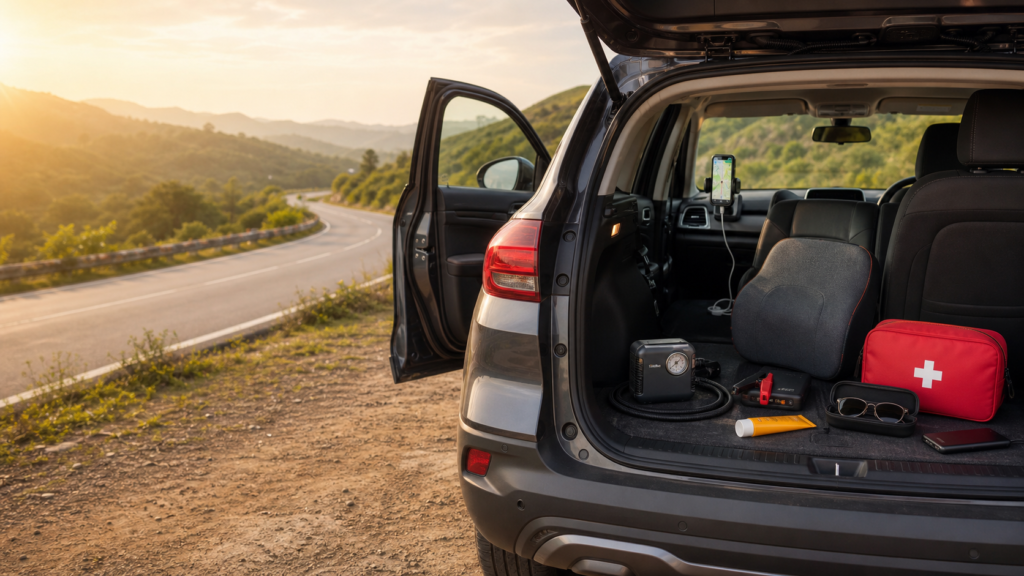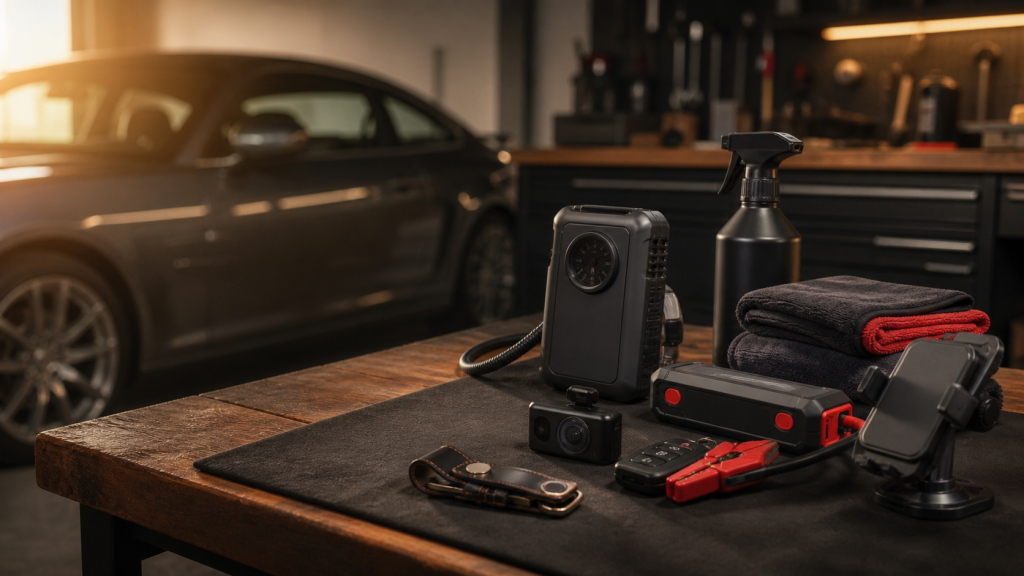
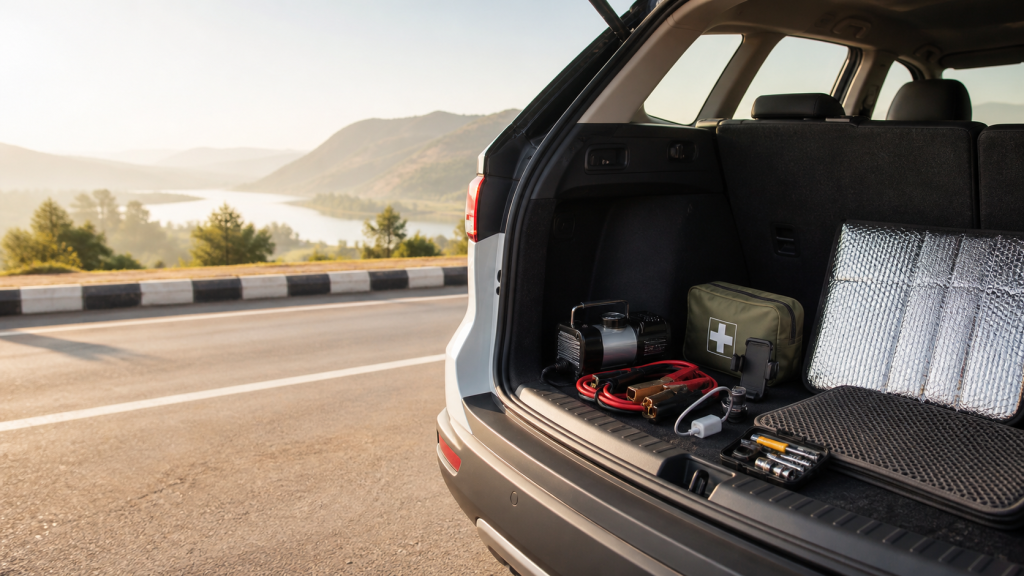
Indian roads can ask a lot of a car and its driver: sudden potholes, unpredictable traffic, monsoon waterlogging, long highway stretches, relentless heat and the occasional breakdown far from help. The answer is not to fill the cabin with gimmicks. It is to carry a small set of accessories that solve real problems—keeping you safe, mobile, comfortable and prepared.
This is a deliberately lean list. These are the accessories worth buying first for daily driving, weekend trips and longer highway runs. Select vehicle-compatible, well-reviewed products and keep them maintained; the most expensive kit is useless if its battery is flat or it is buried under luggage.
The essential checklist
- Dashcam
- TPMS (tyre-pressure monitoring system)
- Tyre inflator
- Tubeless puncture-repair kit
- Phone mount
- Fast car phone charger
- Jumper cables
- 3D floor mats
- Sunshades
1. Dashcam: the accessory you hope never to need
A dashcam records the road ahead, and in some models the rear as well. On crowded city roads, a small scrape can quickly become a disagreement over who did what. On a highway, it can capture an unsafe cut-in, a sudden stop, an impact, road debris or a hit-and-run. The footage can be useful when speaking to your insurer or filing a police report.
Choose a unit with clear daytime and night recording, loop recording, a reliable app and a heat-tolerant design. A hard-wired installation is usually neater and can enable parking monitoring, but confirm that it is installed without affecting your vehicle warranty. Look at brands such as Viofo, 70mai and DDPAI. Memory cards matter too: use a high-endurance card made for continuous recording, not an ordinary phone-storage card.
2. TPMS: catch a slow leak before it becomes a roadside stop
A tyre-pressure monitoring system shows the pressure of each tyre and warns you when one is losing air. This is particularly helpful after a pothole strike or a small nail puncture, when a tyre may deflate gradually rather than immediately. It also makes it easier to spot a pressure imbalance before it affects steering, braking, fuel economy or tyre life.
For an aftermarket system, external-sensor kits are simpler to install; internal sensors are tidier but require tyre removal and fitting. Either way, treat TPMS as an early-warning system, not a substitute for visually checking tyres before a trip. Steelmate, Blaupunkt and Michelin are sensible brands to start comparing. Make sure the display is easy to read and that replacement sensor batteries are available.
3. Tyre inflator: your quickest escape from a low-pressure tyre
A portable inflator is one of the most useful tools in the boot. Use it for a low tyre before leaving home, a slow puncture during a trip or to restore the spare tyre to its specified pressure. It does not replace a tyre shop, but it can get you safely to one instead of leaving you stranded.
For cars, a 12V wired inflator is generally the more dependable choice for repeated use because it draws power directly from the car. Choose one with a digital gauge, preset pressure and auto cut-off. Cordless models are convenient for quick top-ups, but should be charged and tested regularly. Good options to compare include Bergmann, Michelin and Qubo. Check the pressure against a dependable gauge or petrol-pump machine occasionally; small inflators can vary slightly in accuracy.
4. Tubeless puncture-repair kit: a short-term solution when help is far away
A basic plug kit can temporarily seal a small puncture in the tread of a tubeless tyre. It is most useful on a highway, late at night or in a remote area where the nearest puncture shop is not close. Use it with the inflator, then drive cautiously to a professional tyre repairer for inspection and a proper repair.
Do not use a plug kit for sidewall damage, a large tear, a badly damaged tyre or a tyre that has been driven flat. Those situations call for the spare wheel or roadside assistance. A kit from Slime, Michelin or Bergmann is a reasonable starting point. Watch one good tutorial before an emergency: the first attempt should not be on a dark, busy roadside.
5. Phone mount: navigation without distraction
Google Maps is indispensable in unfamiliar parts of a city and on highway diversions, but holding a phone is unsafe and illegal. A sturdy mount keeps the screen at a quick-glance height, allowing you to follow navigation or take hands-free calls without taking your attention from the road for long.
Choose a mount that does not block the windscreen, airbag area, key controls or your view of the road. Vent mounts can be convenient but may droop with heavy phones; dashboard or windscreen mounts need strong, heat-resistant adhesive. Magnetic mounts are excellent only with a compatible case or secure metal ring. Spigen, ESR and Portronics are worth considering.
6. Fast car charger: keep navigation and emergency access alive
Navigation, music, calls and mobile data can drain a phone rapidly, especially on a long drive. A fast charger keeps your phone available for directions, UPI payments, towing assistance and emergency calls. It is a small purchase that pays off every time you are stuck in traffic or travel outside your usual route.
Buy a charger with USB-C Power Delivery or the fast-charging standard your phone supports, plus a quality cable. Avoid mystery-brand chargers that run hot or deliver unstable power. Spigen, Anker, Stuffcool and UGREEN are reliable places to begin. A dual-port model is helpful when a passenger also needs charging.
7. Jumper cables: the backup for a flat battery
A car battery can go flat after leaving an interior light on, parking for several days or simply reaching the end of its life. Jumper cables let you start the car with assistance from another compatible vehicle, saving the wait for a technician in many situations.
Buy suitably thick cables with insulated clamps—not the flimsiest set available—and learn the connection order from your owner’s manual. Confirm the voltage and do not attempt improvised connections. Michelin, Bergmann and Black+Decker are useful brands to compare. If you often travel alone, a dedicated lithium jump starter can be more practical than cables, but it must be kept charged.
8. 3D floor mats: simple protection that you notice every day
Dust, rainwater, muddy shoes and food spills are routine realities in a car. Model-specific 3D mats protect the original carpet and are much easier to remove, wipe or hose down. They also make resale preparation far easier years later.
Prioritise a precise fit, high edges and secure anti-slip retention. The driver’s mat must never slide forward and interfere with pedals. Look at GFX/Galio, Elegant, Pharaoh and Autoform. Avoid buying solely by the “3D”, “5D” or “7D” label; fit, material and pedal clearance matter more than the marketing term.
9. Sunshades: relief from Indian summer parking
A windscreen sunshade is the simplest way to reduce cabin heat when the car is parked in direct sunlight. It makes the steering wheel and seats less punishing to touch, reduces initial air-conditioner load and offers some protection to the dashboard. Side-window shades can add passenger comfort and privacy, but should never compromise outward visibility or local regulations.
For the best result, use a windscreen shade shaped for your exact vehicle and choose side shades that fit securely without affecting window operation. Black Cat, Autofact and Autoform make vehicle-specific options. Remove or fold away anything that obstructs your view before driving.
A sensible buying order
If you are starting from zero, buy in this order: dashcam; TPMS plus inflator; puncture kit; phone mount and charger; jumper cables; then mats and sunshades. The first group protects you from incidents and prevents a roadside problem from getting worse. The final two make daily use more pleasant and preserve the car’s interior.
One final check before every road trip
Accessories support good maintenance—they do not replace it. Before a long drive, check tyre condition and pressures, including the spare; make sure the jack and wheel tools are present; test lights and wipers; and confirm that the dashcam records. Keep the inflator, repair kit and cables easy to reach, not under a fully loaded boot. That small routine is what turns this accessory list into genuine peace of mind.